
Why Texas Is a Prime Market for Freestanding Emergency Rooms
Texas continues to lead national population expansion while many suburban corridors remain underserved by traditional hospital emergency departments. With more than 30 million residents and an annual growth rate that consistently outpaces the national average, the Lone Star State presents one of the most compelling landscapes for freestanding emergency room (FSER) investment in the country. This article explores the structural factors that make Texas uniquely attractive for healthcare infrastructure operators and investors.
Population and Demand Tailwinds
Between 2020 and 2025, Texas added roughly 470,000 new residents per year — the highest absolute growth of any U.S. state. Much of this growth concentrates in suburban and exurban corridors surrounding Dallas-Fort Worth, Houston, Austin, and San Antonio. New master-planned communities, corporate relocations, and job migration create pockets of rapid residential development that dramatically outpace the construction of new hospital campuses.
Hospital emergency departments in these fast-growing suburbs are under immense strain. Average wait times in Texas hospital ERs frequently exceed three to five hours, and overcrowding forces patients to seek alternatives. Freestanding ERs are purpose-built to absorb exactly this kind of demand, delivering shorter wait times, focused triage workflows, and board-certified emergency physicians often within minutes of arrival.
The demographic profile of new Texas residents — working-age families, dual-income households with employer-sponsored insurance — also creates a favourable payer mix for emergency facilities. These communities value proximity, speed, and quality, all hallmarks of the FSER model.
Regulatory and Policy Environment
Texas is one of a handful of states that explicitly permits independently licensed freestanding emergency rooms. The regulatory framework provides a clear path to licensure, and the state's pro-business approach to healthcare development means fewer bureaucratic hurdles compared to states with certificate-of-need (CON) requirements. This regulatory clarity significantly reduces pre-development risk and shortens the timeline from site selection to grand opening.
Additionally, Texas Medicaid expansion discussions and evolving insurer networks continue to broaden the accessible patient base for freestanding facilities. Operators who build strong credentialling relationships with major payers position themselves well for long-term volume growth.
Competitive Landscape and White-Space Opportunities
While Texas hosts more than 700 licensed freestanding ERs, substantial white space remains — particularly in emerging suburbs, underserved rural corridors, and high-traffic commercial zones. Focus Health's market evaluation framework identifies these opportunities through a combination of drive-time analysis, population density modelling, and competitor mapping.
Markets like the DFW metroplex continue to produce new pockets of demand as development pushes north toward Frisco, Prosper, and Celina, and east toward Forney, Rockwall, and Terrell. Houston's western corridors — Katy, Cypress, Fulshear — mirror this pattern. The Austin–San Antonio corridor is another emerging hotbed, driven by tech-sector migration and infrastructure investment.
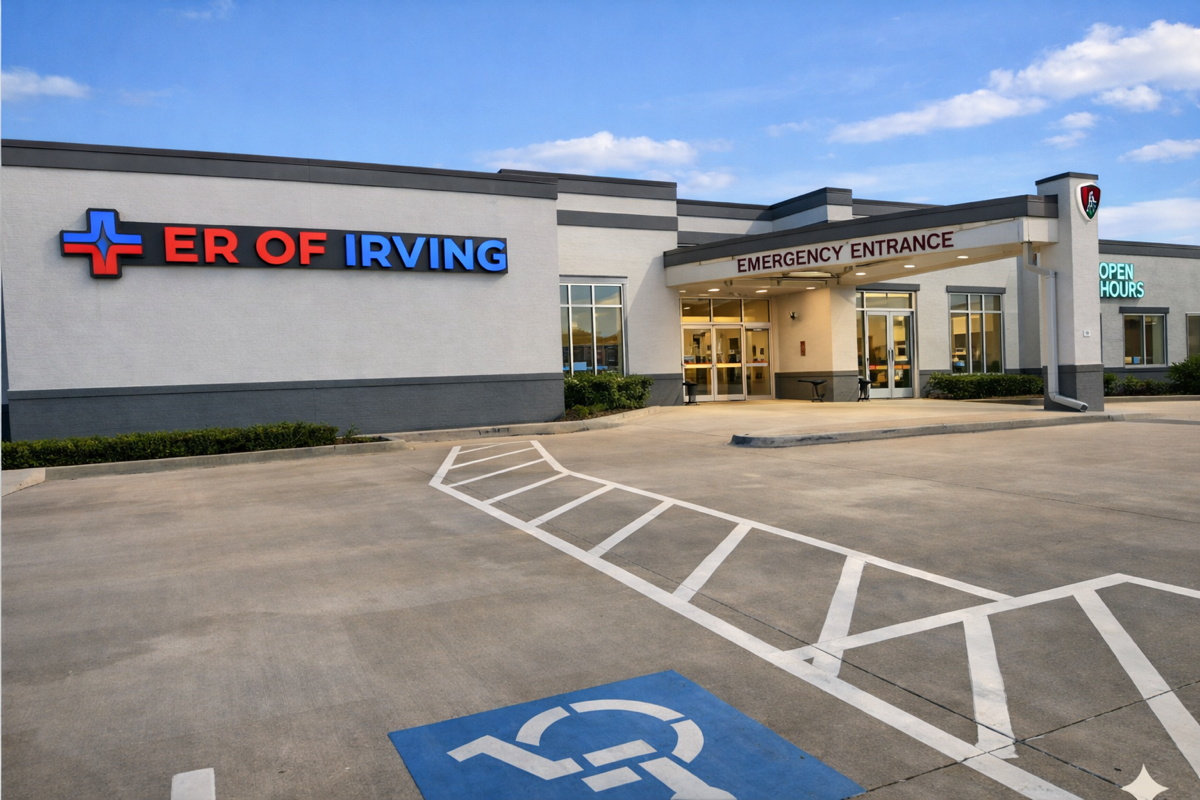
Our facility in Irving, TX is a direct example of this thesis in action: a strategically sited, 24/7 freestanding ER in a high-density commercial-residential corridor near Las Colinas and Valley Ranch, where traditional hospital capacity falls short of community need.
Operational Model Advantages
Freestanding ERs offer structural advantages over hospital-based emergency departments. Purpose-built layouts, smaller overhead structures, and streamlined staffing models allow FSERs to deliver a faster, more focused patient experience. Key operational advantages include:
- Speed: Average door-to-provider times under 10 minutes versus 60+ minutes in hospital ERs.
- Cost efficiency: Lower fixed costs per square foot with targeted diagnostic equipment (CT, X-ray, ultrasound, in-house lab).
- Patient satisfaction: Higher NPS driven by shorter waits, cleaner environments, and dedicated attention from board-certified physicians.
- Scalability: Replicable floor plans and operating playbooks allow rapid multi-site expansion.
Focus Health's turnkey development process leverages these advantages across every new facility launch, ensuring consistent quality and predictable timelines from site selection through operational ramp-up.
Investment Thesis
For partners and investors evaluating healthcare real estate and operations, Texas offers one of the most compelling combinations of population growth, unmet demand, regulatory clarity, and operational scalability. The FSER model delivers strong unit economics with favourable cash-on-cash returns, and the Texas landscape provides a deep pipeline of expansion-ready markets.
Focus Health's vertically integrated Build-Fund-Operate platform is designed specifically to capitalise on these dynamics. By combining disciplined market selection with proven facility development and post-launch operations, we deliver institutional-grade healthcare infrastructure with full-cycle transparency.
What Comes Next
As Texas continues to grow, the gap between population expansion and emergency healthcare capacity will widen. Operators and investors who move with discipline — backed by strong analytics, experienced clinical teams, and repeatable execution models — will capture disproportionate value.
Ready to explore Texas FSER investment opportunities?
Learn more about our investor programme, review the Focus Health portfolio, or contact our team to start a conversation.