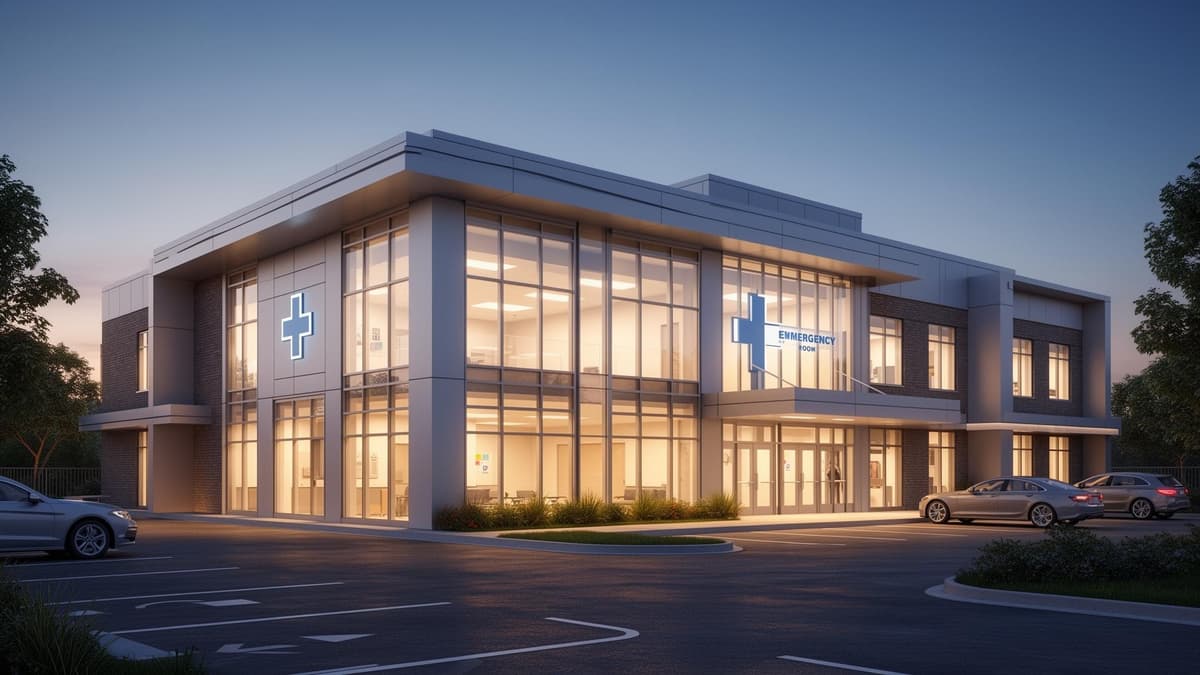

Healthcare Infrastructure vs Traditional Real Estate Returns
Investors seeking stable, risk-adjusted returns are increasingly looking beyond traditional commercial and residential real estate toward healthcare infrastructure. The rationale is straightforward: healthcare demand is fundamentally inelastic, populations age and grow regardless of economic cycles, and purpose-built medical facilities generate operational cash flows that are structurally different from — and in many respects superior to — passive rental income from conventional properties.
This analysis compares healthcare infrastructure investment — specifically freestanding emergency room (FSER) development — with traditional real estate asset classes across key financial metrics. The goal is to provide investors and capital partners with a framework for evaluating healthcare infrastructure as a portfolio allocation decision.
The Traditional Real Estate Baseline
Traditional commercial real estate has long been a cornerstone of institutional and individual investment portfolios. Multifamily, office, industrial, and retail properties offer predictable income streams through lease structures, potential appreciation through value-add strategies, and tax advantages through depreciation. The metrics are well understood:
- Multifamily: Cap rates in major metros have ranged from 4.0–6.0 per cent in recent years, with cash-on-cash returns typically in the 6–10 per cent range for stabilised assets. Value-add opportunities can push total returns higher but introduce renovation risk and lease-up uncertainty.
- Office: The post-pandemic office market has experienced significant disruption. Cap rates have expanded to 6.0–9.0 per cent in many markets, but vacancy rates remain elevated (15–20 per cent nationally), and the structural shift toward remote and hybrid work creates long-term demand uncertainty.
- Industrial: The strongest-performing traditional asset class in recent years, driven by e-commerce and supply-chain reshoring. Cap rates of 4.5–6.5 per cent reflect strong demand, but increasing supply and potential e-commerce deceleration introduce forward-looking risk.
- Retail: Highly bifurcated. Grocery-anchored neighbourhood centres maintain stable performance (cap rates 6.0–7.5 per cent), while discretionary retail faces ongoing structural headwinds from e-commerce.
- Residential single-family rental (SFR): Growing institutional interest has compressed yields. Cap rates of 4.5–6.0 per cent are common, with total returns dependent on appreciation in home values — a metric that is inherently cyclical.
Across all traditional asset classes, returns are fundamentally driven by tenant demand — the willingness and ability of businesses or individuals to pay rent. This demand is economically sensitive, cyclical, and subject to structural disruption (e.g., remote work for offices, e-commerce for retail).
Healthcare Infrastructure: A Different Demand Profile
Healthcare infrastructure — and FSER development in particular — operates under a fundamentally different demand paradigm. People do not choose when they have a medical emergency. They do not defer emergency care because of economic downturns, interest-rate movements, or consumer-sentiment shifts. Emergency healthcare demand is driven by population size, demographic composition, and geographic accessibility — factors that are structural, not cyclical.
This demand inelasticity is the single most important differentiator between healthcare infrastructure and traditional real estate. When the economy weakens, office tenants downsize, retail tenants close, and residential renters double up. Emergency rooms continue to see patients. The 2008–2009 financial crisis, the 2020 pandemic, and subsequent economic dislocations all demonstrated that emergency department volumes remain remarkably stable through economic stress periods.
As detailed in our investor checklist for healthcare infrastructure operators, understanding this demand dynamic is essential for evaluating risk-adjusted returns in the sector.
Comparing Return Profiles
FSER development offers a return profile that differs meaningfully from traditional real estate:
Cap Rate Equivalence
Healthcare facilities typically trade at cap rates of 6.0–8.5 per cent, depending on operator quality, market fundamentals, and lease structure. Purpose-built FSER facilities with demonstrated operating history can command premium valuations due to the specialised nature of the asset and the strength of underlying cash flows. Importantly, healthcare facility cap rates have shown less compression volatility than multifamily or industrial cap rates during the low-interest-rate periods of 2020–2022, suggesting a more stable valuation framework.
Cash-on-Cash Returns
Stabilised FSER facilities generate cash-on-cash returns that typically range from 15–25 per cent, significantly exceeding what most traditional real-estate asset classes produce. This premium reflects the operational complexity of the asset — these are not passive rent-collection vehicles — but it also reflects the genuine economic value created by delivering emergency healthcare services to underserved communities.
The operational component is critical to understand: FSER returns include revenue from patient care (facility fees, professional fees, ancillary services), not just property rental income. Investors who participate in the operating entity — rather than solely the real estate — capture this operational upside.
Recession Resilience
Historical performance data demonstrates that FSER volumes remain stable through economic downturns. While payer mix may shift modestly (increased self-pay or Medicaid during recessions), overall visit volumes are driven by population and acuity — not discretionary spending. This contrasts sharply with office (vacancy spikes), retail (tenant closures), and to a lesser extent, multifamily (rent compression) during recessionary periods.
Revenue Predictability
Stabilised FSERs with strong in-network payer contracts achieve revenue predictability that compares favourably to NNN-leased commercial properties. Monthly patient volumes, average reimbursement per visit, and payer-mix stability create a cash-flow profile that — while not contractually guaranteed like a long-term lease — exhibits less month-to-month variability than many investors expect.
The Operational Complexity Premium
Healthcare infrastructure returns include an operational complexity premium — additional return generated because operating a freestanding ER requires specialised expertise that creates a meaningful barrier to entry. This is not a negative; it is a feature of the asset class that protects returns from compression.
Traditional real estate is increasingly commoditised. Property management, leasing, and even value-add renovation are services available from dozens of competing firms in any major market. This competition compresses operator margins and, ultimately, investor returns. Healthcare operations — recruiting board-certified emergency physicians, managing CLIA-certified laboratories, navigating payer contracts, maintaining DEA registrations, and ensuring clinical quality — require specialised capabilities that few organisations possess.
Focus Health's vertically integrated Build-Fund-Operate platform is specifically designed to deliver this operational capability. Investors who partner with experienced operators capture the complexity premium without bearing the operational burden directly.
FSER Unit Economics
Understanding FSER unit economics helps contextualise the return differential with traditional real estate:
- Average development cost: $2.5–4.5 million per facility (land, construction, equipment, licensing, working capital)
- Time to revenue: 4–6 months from groundbreaking to first patient
- Stabilised annual revenue: $4–8 million per facility (varies by market, volume, and payer mix)
- Operating margin: 20–35 per cent at stabilisation for well-managed facilities
- Breakeven timeline: 6–12 months post-opening for most facilities, depending on market conditions and ramp trajectory
Compare this to a $4 million multifamily acquisition generating $280,000 in annual net operating income (7 per cent cap rate) with limited upside beyond rent growth and appreciation. The FSER development model offers a fundamentally different value-creation pathway — one driven by operational performance rather than passive income.
Institutional Capital and Healthcare Real Estate
Institutional investors — pension funds, endowments, sovereign wealth funds, and large family offices — have increasingly allocated capital to healthcare real estate over the past decade. This trend reflects recognition that healthcare assets offer diversification benefits, recession resilience, and attractive risk-adjusted returns that complement traditional real-estate portfolios.
Medical office buildings, ambulatory surgery centres, and senior-living facilities have attracted the most institutional attention to date. Freestanding emergency rooms represent a newer, higher-return opportunity within the healthcare real-estate spectrum — one that is gaining institutional interest as the asset class matures and operating track records lengthen.
Partnership with experienced operators is the primary pathway for institutional capital to access FSER returns without bearing direct operational risk. Focus Health's platform was built to facilitate exactly this type of capital partnership.
Risk Considerations
Healthcare infrastructure investment is not without risk. Key risk factors include:
- Regulatory risk: Changes in state licensing requirements, balance-billing legislation, or payer-reimbursement policies can affect economics. Texas's current regulatory environment is favourable, but operators must monitor policy developments continuously.
- Operational risk: Clinical quality, staffing, and revenue-cycle management require specialised expertise. Poorly operated facilities underperform regardless of market quality.
- Payer-mix risk: Shifts in insurance coverage — particularly during economic downturns — can affect per-visit revenue. Strong in-network contracting and diversified payer participation mitigate this risk.
- Competition risk: Hospital system expansion into freestanding emergency departments can increase local competition. Market selection and operational differentiation are key mitigation strategies.
These risks are real but manageable through disciplined operator selection, rigorous market analysis, and active portfolio management. They are also well compensated by the return premium that healthcare infrastructure generates over traditional real-estate alternatives.
Conclusion: A Compelling Portfolio Allocation
Healthcare infrastructure — and freestanding ER development specifically — offers a return profile that is structurally different from traditional real estate. Higher cash-on-cash yields, recession-resilient demand, operational-complexity premiums, and favourable unit economics combine to make this asset class a compelling allocation for investors seeking diversification and risk-adjusted returns beyond conventional property investments.
The key enabling factor is operator quality. Healthcare infrastructure returns are only as strong as the team managing the clinical, operational, and financial dimensions of each facility. Investors who partner with experienced, vertically integrated operators — those who control market selection, development, capital structuring, and post-opening operations — are best positioned to realise the full return potential of this asset class.
Explore Healthcare Infrastructure Investment
Review Focus Health’s investor programme or connect with our partnerships team to discuss how healthcare infrastructure fits within your portfolio strategy.